

One of the most common questions I am asked is What is the difference between an Architect vs. Building Designer. Many homeowners assume the difference is obvious, but in my experience, most people are unclear on what actually separates the two. Throughout this article, I will explain that the real difference between an architect and a building designer is not just a title, but the individual’s professionalism, experience, and how they approach design, compliance and delivery.
For transparency, I am an Accredited Building Designer. I have enormous respect for architects, and when I was younger, I believed architecture was the only pathway if you wanted to design homes. Residential design has always been my passion. Over time, practical experience taught me that the architect vs building designer conversation is far more nuanced than most people realise, particularly in the residential space.
What Is an Architect?
When comparing architect vs building designer, the term architect has a very specific legal meaning in NSW and across Australia.
In Australia, only individuals registered with their state or territory Architects Registration Board can legally call themselves architects. Education, experience, or design ability alone does not allow someone to use the title. Without registration, it is illegal to practice as an architect or advertise as one.
In NSW, registration is governed by the Architects Act 2003 and administered by the NSW Architects Registration Board.
How architects become registered
To become a registered architect, a person must complete a clearly defined pathway:
An accredited university qualification, typically a Bachelor’s degree, followed by a Master of Architecture
- Supervised experience under a registered architect, formally logged and signed off
- A minimum of two years full-time practical experience, equating to approximately 3,300 logged hours
- Around five years of formal university study
- Successful completion of the Architectural Practice Examination, including a written exam and a formal interview
Only after completing all of these steps can a person apply for registration and legally use the title architect.
In my experience, many clients assume the word architect is a general description for anyone who designs buildings. In reality, it is a protected title under Australian law, and only those who hold and maintain current registration are permitted to use it.
You can read the full and current registration pathway directly from the NSW Architects Registration Board here:
Becoming a registered architect in NSW
https://www.architects.nsw.gov.au/becoming-registered
What is a Building Designer?
In NSW, the title Building Designer is not protected in the same way as architect. At the time of writing, anyone can legally call themselves a Building Designer. An architect, engineer, draftsperson or new business owner can all use the title.
This surprises many people and creates confusion in the architect vs building designer conversation. Not all Building Designers operate at the same level, and the title alone does not indicate experience, capability or accountability.
Because of this, an important distinction exists between a Building Designer and an Accredited Building Designer.
Why the term Building Designer exists
Most homeowners refer to anyone who designs buildings as an architect, and everyone else as a draftsperson. The term Building Designer emerged as residential projects became more complex.
Modern residential design requires far more than drawing house plans. Designers must navigate planning controls, approval pathways, compliance with the Building Code, consultant coordination, and detailed construction documentation. The Building Designer role expanded to cover this broader scope, sitting independently from architecture and drafting.
Other building classes under NSW legislation
Outside of residential apartment developments, the scope of work for Architects and Accredited Building Designers in NSW is far more aligned than most people realise.
If properly registered as a Design Practitioner under the NSW Design and Building Practitioners scheme, both Architects and Building Designers can design and document a wide range of regulated buildings, including:
- Class 3 buildings such as boarding houses and certain residential accommodation
- Class 9c buildings such as aged care facilities
In addition, for non regulated or differently regulated building classes, both professions are commonly involved in the design and documentation of:
- Class 4 to Class 8 buildings, including small commercial, retail, office and industrial buildings
- Class 9a and 9b buildings, such as health buildings, assembly buildings and public facilities
The NSW Government framework makes it clear that the determining factor is not whether someone is an architect or a building designer, but whether they are appropriately qualified, registered where required, and acting within the scope defined by legislation.
My experience in practice
From my experience, the real difference in outcomes between an architect and an Accredited Building Designer rarely comes down to the title alone.
It comes down to the individual’s professionalism, experience, understanding of the planning system, and ability to coordinate consultants, approvals and construction documentation effectively.
For most low-rise residential and mixed-use projects in NSW, both professions are legally capable of delivering compliant, well-designed buildings. Knowing where the legal line sits helps clients make informed decisions, rather than relying on assumptions about titles.
Accredited Building Designer vs Building Designer
Because the title Building Designer itself is not regulated, professional accreditation is where the real difference lies.
An Accredited Building Designer is someone who has met defined education, experience and professional standards through an industry body such as the Building Designers Association of Australia (BDAA).
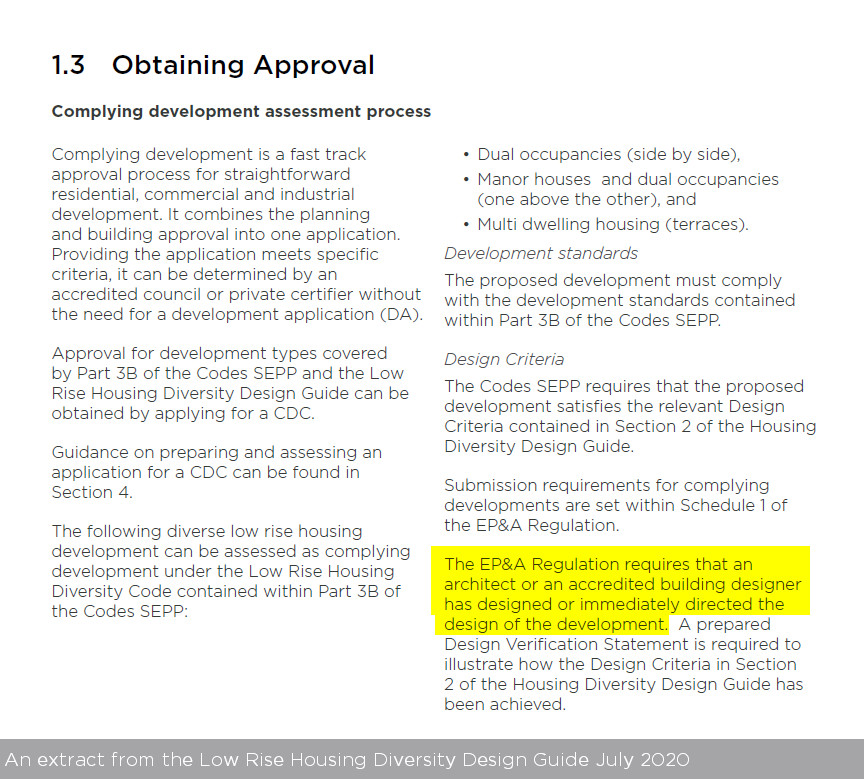
At the time of writing, this distinction matters in NSW. Under the Low Rise Housing Diversity Code and the Pattern Book Code, duplexes, terraces and manor houses may only be designed by either a registered Architect or an Accredited Building Designer. This requirement sets a clear minimum standard for competency, experience and professional accountability for these housing types.
These provisions confirm that the NSW Government recognises Accredited Building Designers as suitably qualified professionals, alongside registered Architects, to undertake the design and documentation required for this form of development. The extracts below from the Low Rise Housing Diversity Design Guidelines and the Environmental Planning and Assessment Regulation 2021 show this recognition in black and white.
Pathway to becoming an Accredited Building Designer
Accreditation through the Building Designers Association of Australia is not automatic. It requires meeting clear criteria relating to qualifications, experience and professional conduct.
Qualifications can vary. Some Accredited Building Designers have completed university degrees in architecture but chose not to pursue architectural registration. Others hold overseas architecture qualifications that are not recognised by Australian registration boards. Many complete formal building design qualifications through TAFE or similar institutions, such as diplomas or advanced diplomas in building design.
To become an Accredited Building Designer with the BDAA, an applicant must meet requirements that include:
- Recognised qualifications in building design or a related discipline
- Demonstrated industry experience in building design
- A portfolio of work that shows competency across design, documentation and compliance
- Professional indemnity insurance
- Commitment to ongoing professional development
- Adherence to a professional code of conduct
These requirements are assessed as part of the accreditation process and are outlined in detail by the BDAA.
You can view the current accreditation criteria directly on the Building Designers Association of Australia website.
https://bdaa.com.au/Web/Accreditation/Building-Designer-Accreditation.aspx
Capability comes down to the individual
Just like architects, the capability of a Building Designer does not come down to the title alone.
In my experience, it comes down to the individual’s professionalism, experience, technical knowledge and understanding of the approval and construction process.
There are Building Designers who operate at a very high level, producing compliant, well documented and highly buildable designs. There are also those whose work is limited to basic drafting. The same variation exists within architecture.
This is why accreditation, experience and demonstrated work matter far more than the label someone uses.
Architect vs Building Designer: Where Does a Draftsperson Fit?
A draftsman, now more commonly referred to as a draftsperson, was traditionally the professional responsible for producing technical drawings for designers, engineers and other specialised consultants. Historically, this work was completed by hand using drawing boards. As technology advanced, the role evolved to Computer Aided Drafting (CAD) and later Building Information Modelling (BIM) software.
As the construction and design industry has become more complex, so too has the role of the draftsperson. Today, drafting is far more specialised, and many professionals work under defined titles such as CAD Operator, CAD Coordinator, BIM Technician or BIM Coordinator, each focusing on specific technical outputs rather than overall design responsibility.
Architects, Accredited Building Designers, structural engineers, civil engineers, land surveyors and other specialised consultants regularly rely on the skills of draftspeople to produce the detailed technical drawings required for approvals and to clearly communicate designs to builders, certifiers and councils.
Some architects and Accredited Building Designers still undertake drafting work themselves where appropriate. However, their skillset is typically better applied to design development, regulatory compliance, coordination of consultants and managing the overall project outcome rather than purely producing drawings.
This is where confusion often arises. Both architects and building designers are capable of drafting, but drafting is only one component of what they do. A draftsperson today would rarely take on the role of a designer or project coordinator. Their work is focused on accurately documenting information provided to them, rather than developing design solutions, interpreting planning controls or managing approvals.
This distinction is important when choosing the right professional for a project. Drafting is a critical skill, but it is not the same as design responsibility, regulatory interpretation or professional accountability.
Architect vs Building Designer: What Types of Buildings Can Each Design?
One of the biggest misconceptions I see when people compare an architect vs a building designer is the assumption that architects can design more building types, or that building designers are limited to simple houses. In NSW, that is not the case.
In practice, Architects and Accredited Building Designers work across many of the same building classes, with one key exception that is worth understanding.
Residential buildings and low rise housing
Both registered Architects and Accredited Building Designers commonly design:
- Detached houses
- Dual occupancies and duplexes
- Terraces and manor houses
- Townhouses and villa developments
- Alterations and additions
- Secondary dwellings and granny flats
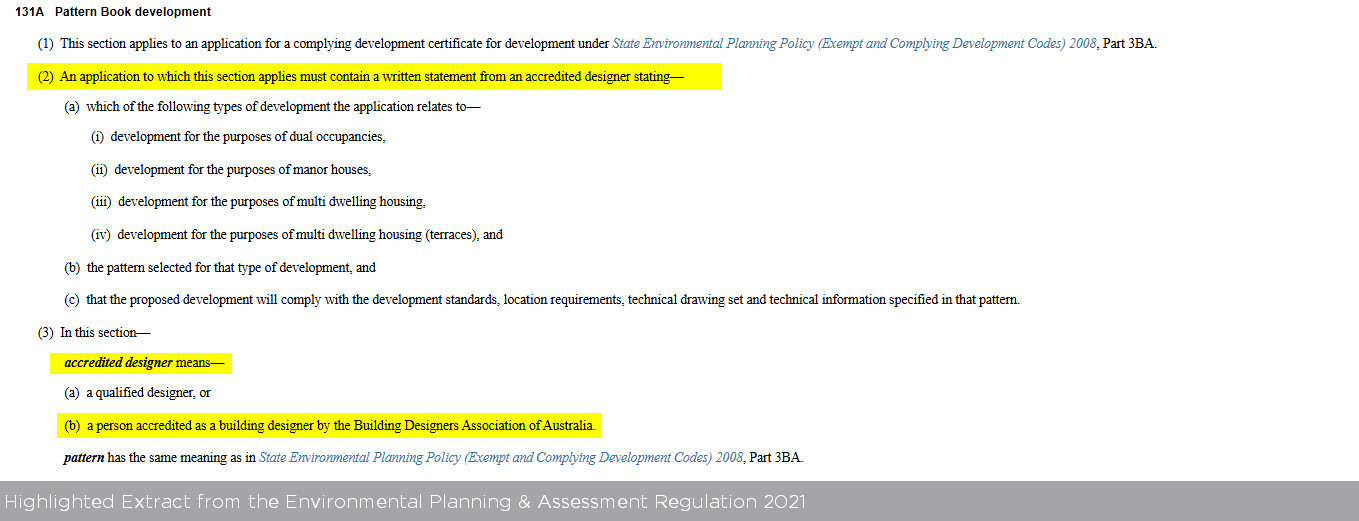
At the time of writing, this distinction is particularly important in NSW. Under the Low Rise Housing Diversity Code and the Pattern Book Code, duplexes, terraces and manor houses can only be designed by either a registered Architect or an Accredited Building Designer. This requirement exists specifically to ensure a minimum level of competency and accountability for these housing types.
These provisions confirm that the NSW Government recognises Accredited Building Designers as suitably qualified professionals, alongside registered Architects, to undertake the design and documentation required for these forms of development, as demonstrated by the extracts from the Low Rise Housing Diversity Design Guidelines and the Environmental Planning and Assessment Regulation 2021.
Take away
When comparing an architect vs building designer, there is no single answer that suits every project. Both professions play an important role in the design and delivery of buildings in NSW, and both can produce high-quality, compliant and well-considered outcomes when working within their expertise.
In residential design especially, the architect vs building designer discussion often comes down to experience, approachability, cost expectations and how closely the designer understands local planning controls and construction realities. Titles matter, but capability, professionalism and accountability matter more.
If you are unsure whether an architect vs building designer is the right fit for your project, do not be afraid to reach out. A quick phone call or email can help clarify whether we are the right designer for your project and whether our experience aligns with what you are trying to achieve.


